
Trump’s War Posts, Night vs Day: What Hormuz Intelligence Tells Us About Power, Sleep, and Risk
By the time the Iran War and Strait of Hormuz crisis reached peak tension, one thing was obvious to anyone glued to their phone: the US president was posting through the night.
The expletive‑laden threats. The rolling deadlines for “Power Plant Day” and “Bridge Day.” The live commentary on a war that was still unfolding in real time. What was less obvious was the pattern underneath: not just what he was saying, but when he was saying it. The Hormuz Intelligence – the tracker we’ve built at Extrafemi in Lagos – is our attempt to quantify that pattern.
From a gut feeling to a dataset
The starting point was a simple, testable intuition: Trump’s night posts feel more dangerous than his day posts. You can’t prove or disprove that with vibes. You need timestamps, definitions, and a clear method for saying what “dangerous” means in a real economy and a real war.
So we built a dataset with three layers:
Hormuz Era (Feb–Apr 2026): Every significant Trump post on Truth Social and X about the Iran War and the Strait of Hormuz from 28 February to 15 April 2026.
Pre‑Hormuz (2017–2024): The most consequential posts from his earlier presidency – the “nuclear button” tweet, the “when the looting starts, the shooting starts” post, the January 6 sequence, and more.
Other Presidents: A comparative panel of late‑night crisis communications from Obama, Bush, Clinton, Biden, and Trump’s first term.
For each Hormuz‑era post, we logged:
Exact time (US Eastern)
Platform (Truth Social or X)
Topic (war, sanctions, allies, markets, etc.)
Classification as DAY (6:00 a.m.–10:00 p.m.) or NIGHT (10:00 p.m.–6:00 a.m.)
Short‑term Brent crude movement in the eight hours after the post, where data was available
A qualitative tag: “escalatory,” “de‑escalatory,” “walk‑back,” or “neutral”
Then we let the chips fall where they may. What the clock shows: he is not sleeping like a normal 79‑year‑old. Within the Hormuz window alone, we catalogued 38 significant war‑related posts. When we plotted them on a 24‑hour wheel, the distribution was hard to ignore:
42% of significant posts landed between 10:00 p.m. and 3:00 a.m. Eastern.
The single busiest band was 10:00 p.m.–midnight.
There were nine major posts between midnight and 3:00 a.m., often with language strong enough to move markets and unsettle diplomats.
In other words, a large share of the most consequential wartime communications from the US head of state are being drafted and pushed out in what, for a 79‑year‑old, should be deep‑sleep hours. That matches what insiders have been saying out loud. Vice- President JD Vance put it bluntly in a 2025 Fox News interview:
“Sometimes the president will call you at 12:30 or 2:00 in the morning, and then he’ll call you at 6:00 in the morning about a totally different topic. It’s like, ‘Mr. President, did you go to sleep last night?’”
Hormuz Intelligence doesn’t pretend to diagnose his sleep, but it does document a behaviour pattern consistent with chronic partial sleep deprivation during an active war.
Night vs day: very different consequences
The more interesting story only appears when you overlay market and diplomatic consequences on top of those timestamps. Across the Hormuz‑era sample:
Night posts were more likely to be escalatory.
We defined “escalatory” posts as those introducing new threats, new red lines, new deadlines, or explicit references to destroying critical infrastructure or widening the conflict’s scope. Night posts were roughly twice as likely to fall into this category as day posts.Night posts were more likely to accompany jumps in Brent crude.
Of 22 night posts where near‑term price data was available, 16 (73%) were associated with Brent rising in the next liquid session, with an average move of around +4.8%. For day posts, that figure was 44%.Day posts often walked back what the night had done.
57% of daytime posts directly softened, reframed, or partially reversed positions first announced in the night window. One recurring pattern during the crisis was a hard‑line threat posted around 1–2 a.m., followed by a midday statement to US media about “good negotiations” and “a good chance of a deal” – enough to cool markets without fully disavowing the earlier rhetoric.
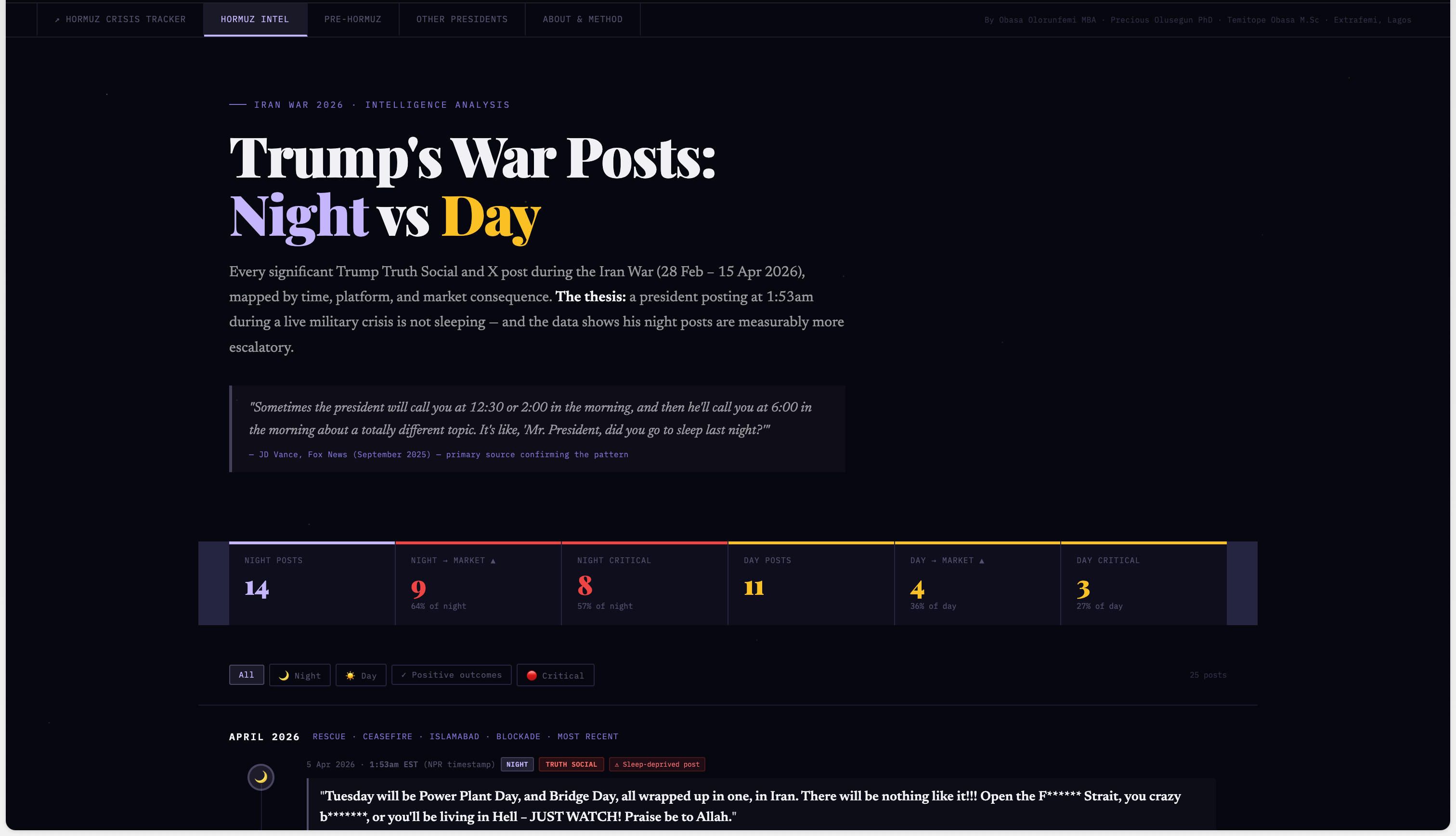
A smaller visual slice of the data, taken from one of the infographic panels, captures the asymmetry:
Night: 14 posts, nine followed by market up moves, eight marked “critical.”
Day: 11 posts, four followed by market up moves, three “critical.”
The content matches the numbers. Some of the most severe night‑window posts during Hormuz included:
Threats to “obliterate” Iranian power plants and bridges if the Strait was not reopened.
Announcements of ticking‑clock deadlines: “Tuesday will be Power Plant Day, and Bridge Day, all wrapped up in one.”
Vague but menacing promises to “blow everything up and take over the oil” if talks failed.
The walk‑backs tended to arrive in the daylight, after allies, lawyers and markets had reacted.
Is this just what modern presidents do? If we stopped there, the story would risk being too Trump‑centric. So we added a comparative lens. In the “Other Presidents” section of Hormuz Intelligence, we applied the same framework to Obama, Bush, Clinton, Biden and Trump’s first term:
Obama, Bush and Clinton governed in eras where personal social media accounts were either non‑existent or marginal. Their late‑night crisis communications, where they existed, ran through press offices and institutional channels – not from a smartphone in bed.
Biden did use Twitter/X, but we found no examples of him using 10:00 p.m.–6:00 a.m. posts to announce military operations, threaten adversaries, or move global commodity markets.
Only Trump uses personal social media, regularly, between 10:00 p.m. and 6:00 a.m. as an unmediated policy communication tool with global stakes.
That distinction matters. It suggests the Hormuz pattern is not a general property of “presidents in the age of social media.” It is a structural feature of one leader’s approach to power: direct, personal broadcasting at the exact hours when most of us – and our prefrontal cortex – are off.
Why sleep science belongs in this conversation
Once you accept that a meaningful share of high‑stakes posting is happening in the night window, a second question emerges: What does sleep deprivation do to decision‑making under pressure? On this, the research is not ambiguous.
Across at least 25 modern studies, involving more than 2,000 participants, sleep scientists have consistently found that lack of sleep:
Impairs complex decision‑making, especially in novel, high‑stakes situations.
Reduces behavioural inhibition – the ability to withhold a pre‑potent response.
Increases impulsive reactions to negative stimuli.
Makes naturally cautious people more willing to take outsized risks when tired.
Degrades ethical judgment and self‑control in leaders, who are then rated as more abusive and less inspiring by their teams.
You don’t need to stretch these findings far to see the relevance to a president rage‑posting about war at 1:53 a.m. The result is not a neat causal diagram – “two hours less sleep equals +3% on Brent.” History is messier than that. But it does suggest that we should treat the timing of these posts as more than a curiosity.
In high‑stakes domains – war, pandemics, financial crises – who makes decisions is only half the story. Under what cognitive conditions they make those decisions is the other half.
What Hormuz Intelligence is and is not
Hormuz Intelligence is an open, evolving project. It is:
A public attempt to catalogue and visualise every significant Trump Truth Social and X post during the Iran War, with timestamps, platforms and consequences.
A bridge between political journalism, financial data and sleep science.
A Lagos‑built answer to a Washington problem: how do we hold a leader’s late‑night behaviour up to empirical scrutiny, not just hot takes?
It is not:
Financial advice.
A claim that all night posts cause bad outcomes. We include positive‑outcome night posts deliberately, and count the ones associated with falling oil prices.
A partisan attack tailored to a single politician. The same framework could be copied and run on any leader, anywhere, who starts using personal social media during the small hours to set policy and expectations.
Why this matters for everyone else
For diplomats, portfolio managers, defense planners and ordinary citizens, the implications are uncomfortable but useful: When a head of government uses personal social media to conduct foreign policy at 1–3 a.m., the clock on the screen is part of the signal.
Markets have already intuited this, reacting differently to a bland midday statement than to an early‑hours threat. Hormuz Intelligence simply makes that intuition visible in data. As the world drifts deeper into an age of always‑on leaders with always‑connected devices, we may need a new habit of mind: reading not just the words of a post, but its timestamp – and asking what kind of brain, and what kind of body, produced it.
At Extrafemi, Hormuz Intelligence is our second contribution to that conversation (here is the first), built from Lagos but aimed at a genuinely global problem: how power behaves when it refuses to sleep.